
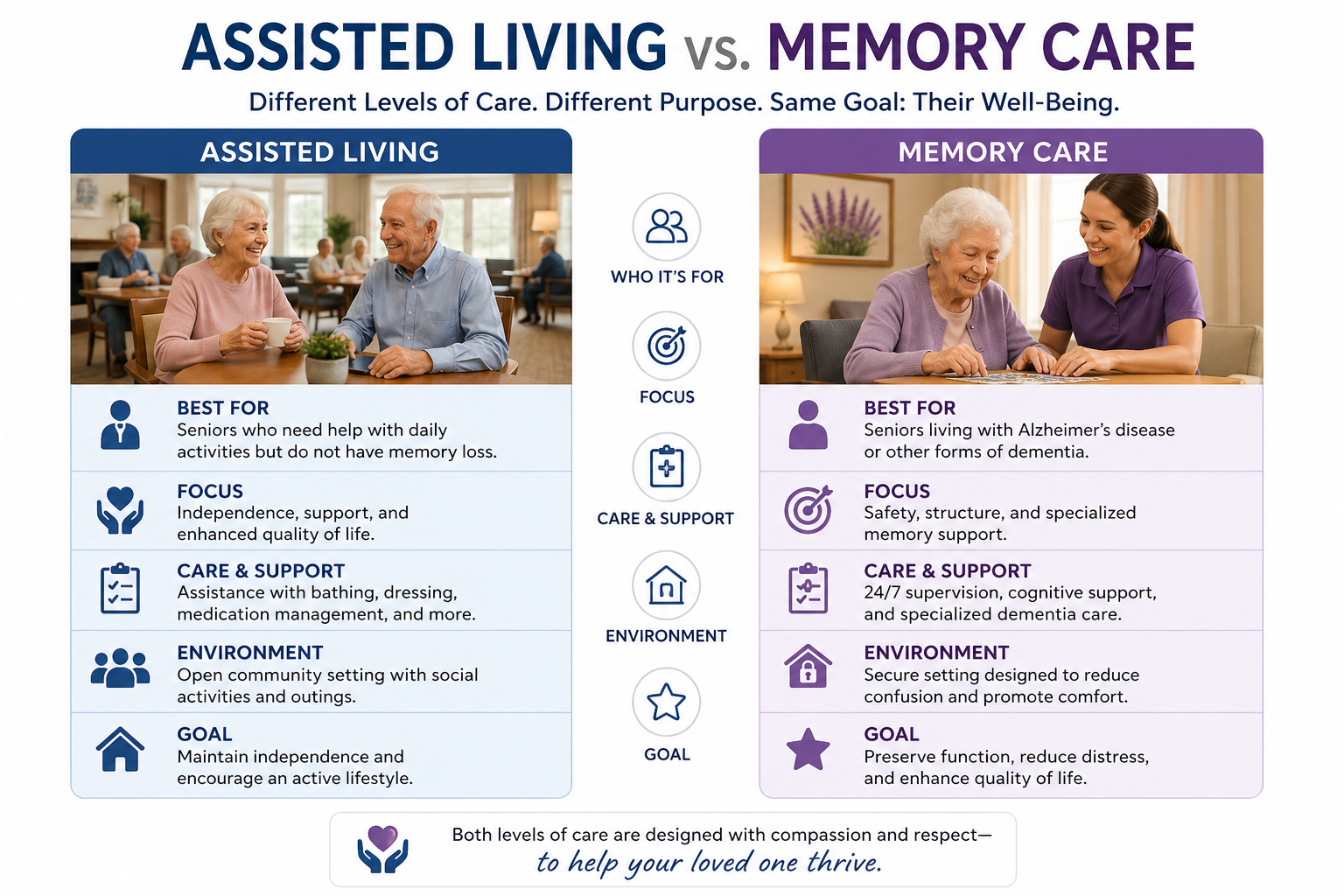
Choosing the right level of care for an aging parent is one of the most important — and emotionally complex — decisions a family can make. Two of the most common options families explore are assisted living and memory care, and while they may sound similar, they serve very different needs. Understanding the assisted living vs. memory care differences can help you feel confident that your loved one is placed in the right environment — one that supports their safety, dignity, and quality of life.
At Lantern Crest Senior Living in Santee, CA, we work with families throughout the greater San Diego area every day to help them navigate this exact decision. This guide breaks down what each care level offers, how they differ, and the signs that can help you determine which is the right fit for your loved one.
What Is Assisted Living?

Assisted living is a residential care setting for seniors who need support with some activities of daily living but do not require the round-the-clock medical attention of a skilled nursing facility. It bridges the gap between fully independent living and more intensive care.
In an assisted living community, residents typically live in private or semi-private apartment-style accommodations and receive personalized help with tasks such as:
- Bathing, dressing, and grooming
- Medication management and reminders
- Mobility assistance and fall prevention
- Meals and nutrition
- Transportation to appointments and outings
Importantly, assisted living residents generally have their cognitive faculties largely intact. They may have physical limitations or chronic health conditions, but they can still communicate their needs, recognize family members, and participate in social activities with meaningful engagement. At Lantern Crest, our assisted living program — located in The Ridge — provides 24-hour care from a dedicated staff, while still allowing residents to maintain their independence and enjoy resort-style amenities.
What Is Memory Care?

Memory care is a specialized form of long-term senior care designed specifically for individuals living with Alzheimer’s disease, dementia, or other forms of cognitive decline. It goes significantly beyond what standard assisted living provides, offering a higher staff-to-resident ratio, a secured environment to prevent wandering, and programming built around the unique needs of those with memory loss.
Key features of memory care include:
- Staff trained in dementia care techniques and behavioral support
- Secure, thoughtfully designed living spaces that reduce confusion and risk
- Structured daily routines that provide comfort through predictability
- Therapeutic programming such as music therapy, sensory activities, and reminiscence programs
- Coordination with physicians and specialists in Alzheimer’s and dementia care
At Lantern Crest Senior Living, our Memory Care Neighborhood is uniquely suited for residents with Alzheimer’s and dementia care needs. Families who have entrusted us with the care of their loved ones often describe a sense of relief — knowing their parent is in a warm, family-like atmosphere with compassionate caregivers who understand how to communicate with and support someone experiencing cognitive decline.
What Are the Key Differences Between Assisted Living and Memory Care?
The most important distinction comes down to cognitive health. Assisted living is designed for seniors who are physically dependent but cognitively capable, while memory care is designed for seniors whose primary care challenges stem from cognitive impairment.
Here is a side-by-side comparison of the core differences:
- Level of supervision: Assisted living offers support as needed; memory care provides continuous, specialized supervision
- Staff training: Assisted living staff are trained in general senior care; memory care staff receive specialized training in dementia behavior, communication, and crisis de-escalation
- Environment: Assisted living communities are typically open and social; memory care neighborhoods are secured and intentionally designed to reduce disorientation
- Programming: Assisted living activities focus on social engagement and recreation; memory care activities are therapeutic and cognitively tailored
- Cost: Memory care generally costs more due to the higher level of specialized staffing and programming involved
Understanding these differences is critical when evaluating placement options — choosing the wrong level of care can put a senior’s safety at risk or, equally, place them in a more restrictive environment than their needs require.
How Do You Know When Memory Care Is Needed?
One of the most common questions families ask us at Lantern Crest is: “Has the time come for memory care?” There is rarely a single defining moment. Instead, families often describe a gradual shift — a pattern of concerning behaviors that accumulates over time until safety becomes a real worry.
Signs that memory care may be the right next step include:
- Frequent wandering or becoming lost in familiar environments
- Inability to recognize close family members or longtime friends
- Repeated dangerous behaviors such as leaving appliances on or forgetting to eat
- Significant personality changes, including aggression, paranoia, or severe mood swings
- A formal Alzheimer’s or dementia diagnosis from a physician
- Caregiver burnout, where family members can no longer safely manage care at home
If several of these signs are present, it is worth scheduling a consultation with a senior care advisor who can assess your loved one’s needs and help determine the appropriate care setting.
Why the Right Environment Makes All the Difference
Placing a senior with dementia in a standard assisted living environment — without the specialized structure and secured setting of memory care — can increase anxiety, confusion, and safety risks. Conversely, placing a cognitively healthy senior in a memory care environment may feel unnecessarily restrictive and limit their quality of life.
At Lantern Crest Senior Living, we are proud to offer both assisted living and memory care within our Santee campus, along with independent living and villa living options. This continuum of care means that if a resident’s needs change over time, they can transition to a higher level of support without the additional trauma of relocating to an unfamiliar community. For families, this offers tremendous peace of mind — and for residents, it preserves the sense of home they have built within our community.
Our campus is also home to an award-winning chef and dining facilities, beautiful gardens, a swimming pool, and a vibrant calendar of activities — ensuring that residents at every level of care enjoy a fulfilling, dignified daily life.
Frequently Asked Questions About Assisted Living vs. Memory Care
What is the main difference between assisted living and memory care?
The main difference is the level and type of care provided. Assisted living supports seniors who need help with daily tasks but do not have significant cognitive decline. Memory care is specifically designed for individuals with Alzheimer’s, dementia, or other memory-related conditions, offering a secured environment and staff trained in cognitive care techniques.
Can a resident move from assisted living to memory care?
Yes. Many senior living communities, including Lantern Crest Senior Living in Santee, CA, offer both care levels on the same campus. This allows residents to transition to a higher level of care without the disruption of relocating to an entirely new community — which is especially important for seniors with cognitive decline.
How do I know if my parent needs memory care instead of assisted living?
Signs that memory care may be needed include frequent wandering, inability to recognize family members, repeated dangerous behaviors, and significant personality changes. If your loved one has been diagnosed with Alzheimer’s or a related dementia, a memory care community is typically the safer and more appropriate choice.
Is memory care more expensive than assisted living?
Memory care typically costs more because it requires specialized staff training, secured facilities, and individualized programming for residents with cognitive conditions. In the San Diego area, we encourage families to schedule a tour at Lantern Crest to discuss current pricing and everything that is included in our care programs.
What activities are offered in memory care communities?
Memory care communities offer structured, therapeutic activities designed to engage residents with Alzheimer’s or dementia. These often include music therapy, reminiscence programs, sensory activities, gentle movement, and social engagement. At Lantern Crest, memory care residents enjoy vibrant, purposeful daily programming designed to support cognitive function and emotional well-being.
Does Lantern Crest Senior Living offer both assisted living and memory care?
Yes. Lantern Crest Senior Living in Santee, CA offers assisted living, memory care, independent living, and villa living — all within one trusted community. Call 619-258-8886 or visit our website to schedule a tour today.
Finding the Right Care for Your Loved One
Understanding the difference between assisted living and memory care is the first step toward making a confident, informed decision for your family. Both levels of care serve an important role — and both can offer a safe, engaging, and dignified home for your loved one when matched correctly to their needs.
At Lantern Crest Senior Living, our experienced team is here to walk alongside your family through every step of this process. We invite you to tour our Santee community, meet our caregivers, and see firsthand the warmth and quality of life we provide across all our care levels. Because every senior deserves a home that truly fits who they are — and where they are right now.